
Reflecting on a powerful moment at the LCR Food Systems Roadmap launch
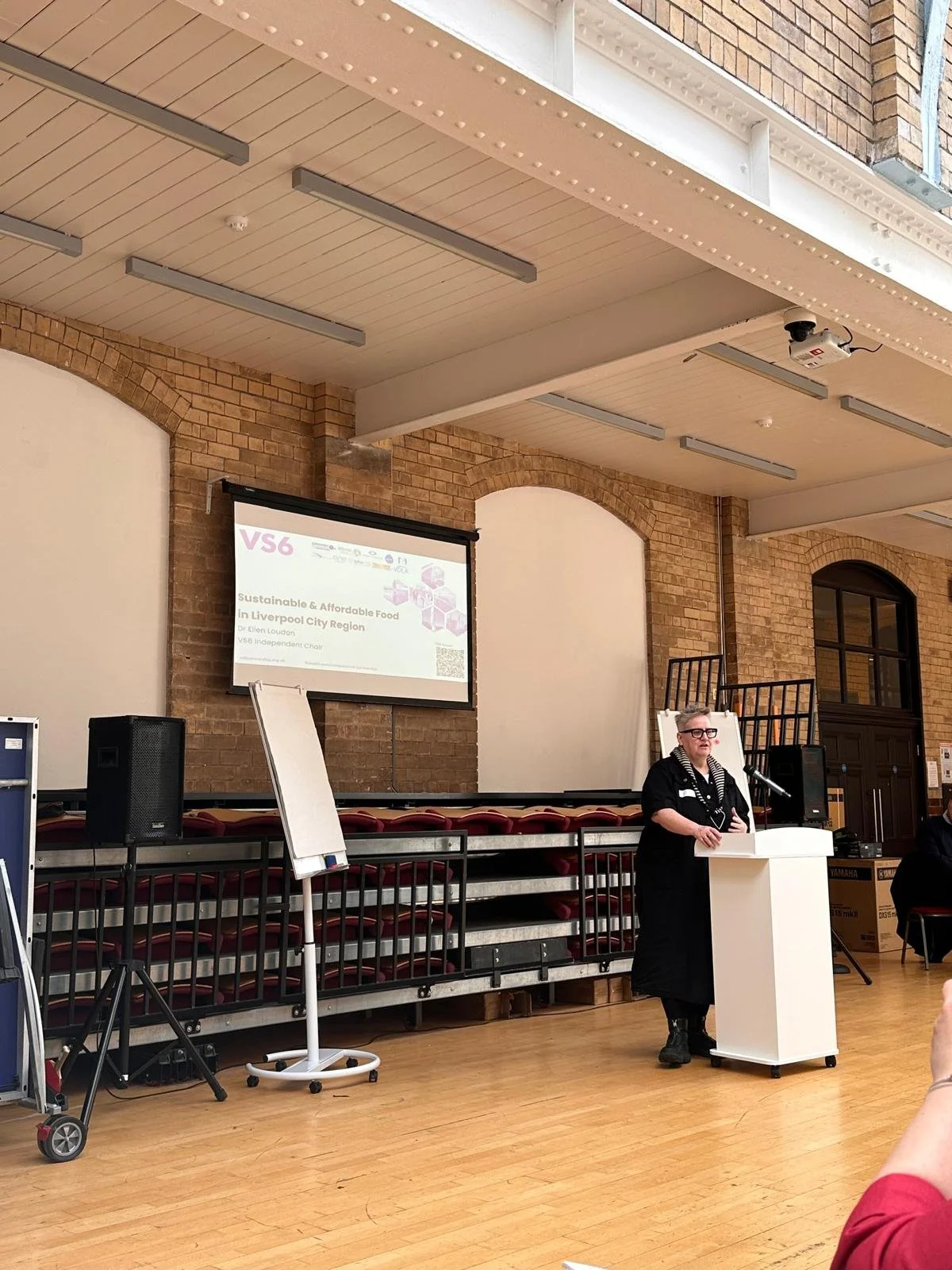
Monday’s launch of the Liverpool City Region Food Systems Roadmap, organised by Feeding Liverpool, was a significant milestone for our region’s collective response to tackling food poverty.
The event brought many different sectors together, and the response in the room was overwhelmingly positive. A sign that as a city region, we are ready to push harder, think bigger, and work more collaboratively toward a fairer, more resilient food system.
Cross sector collaboration and collective responsibility is key to tackling this crisis – a fundamental truth to which VS6 Chair Dr Ellen Loudon emphasised in her compelling and impactful speech. Ellen spoke with clarity and conviction about the role of our VCFSE sector in tackling food insecurity, a crisis that the sector cannot tackle alone, and she bravely challenged us all - policymakers, partners, and system leaders - to go further.
Read the speech in full below, co-authored by Rev Canon Dr Ellen Loudon, Chair of the VS6 Partnership, and Laura Tilston, VSNW Policy & Research Programme Manager.
Colleagues, partners, and friends,
As Chair of the VS6 Partnership, I have the privilege of working alongside the extraordinary voluntary, community, faith and social enterprise (VCFSE) organisations that make up the backbone of our Liverpool City Region. And today, I want to speak plainly about both the scale of the challenge we face and the urgency of the action required from all of us but particularly our political leaders.
10 years ago, I took up the role of Director of Social Justice in the Diocese of Liverpool and Canon Chancellor at Liverpool Cathedral and was asked to Chair the charity, Micah Liverpool. Micah supports a foodbank that hands out up to 250 emergency food parcels each week. 10 years ago I expected the need for this almost United Nations scale food aid provision would end in a matter of years. I assumed that no government would want this level of poverty to continue for any significant period of time.
But I was wrong. Here we are 10 years later and the situation is worse.
I don’t want to be here in 10 years’ time going over the same issues. I, like all of us here, want to see the closure of foodbanks and the end to food poverty.
The VS6 Partnership’s report Sustainable and Affordable Food for Liverpool City Region: Recommendations for Change (2022) sets out, with clarity and compassion, the reality facing too many of our residents.
Significant numbers of families across our city region are experiencing food insecurity, a situation worsened by the ongoing cost-of-living crisis, climate change and war.
Before 2022, many were already struggling to access affordable, healthy food sustainably. Now, even more people face impossible choices, and the crisis has deepened.
Our community food mapping shows just how extensive the VCFSE sector’s response has become: almost 300 food banks, pantries, community growers, and food alliances are operating in every corner of the City Region. A community food economy.
But the situation is stark. Donations and funding are continuing to fall while demand is rising.
The Trussell Trust reported that 2.6 million food parcels were distributed across the UK in 2015. That’s one parcel every 12 seconds, with over 900,000 of these provided for children.
Citizens Advice data shows that over 16,000 people were supported with food bank referrals in February 2026 alone. For the entirety of 2025, 206,845 people were referred to food bank crisis support.
Additionally, House of Commons research found that
Disabled people make up 69% of people referred to Trussell food banks.
People who live in social housing make 46% of those referred to a food bank.
Private renters make up and 22% of those referred to food banks.
89% of people referred to Trussell food banks receive means tested benefits.
Our most vulnerable people in society are living in food insecurity. This is unsustainable, and it is unfair.
We know that our work is constrained by centralised decision‑making and national policy. While we are relieved by the recent announcement that the two‑child benefit cap will be removed from April 2026 (an important step expected to lift an estimated 450,000 children out of poverty and support a further 1.5 million children) this change, though significant and hard‑won through years of campaigning by VCFSE organisations, is only one piece of the puzzle.
It represents progress, but not transformation. Structural barriers remain deeply embedded in our welfare system, our labour market, and our wider economic policies. These barriers continue to prevent families and communities across the Liverpool City Region from building secure, healthy, and thriving lives.
To achieve real and lasting change, we must go much further than this. The removal of the cap must be the beginning, not the end of a comprehensive programme of reforms that addresses poverty at its roots, not just at its sharpest edges.
And yet, the real message of our reports is this: the VCFSE sector cannot and must not be left to shoulder this alone. If we are truly to make food poverty history in the Liverpool City Region, systemic change must be embraced. We need both public and private sectors to work with us in order to do this.
Our 11 recommendations set out a strong, practical path for the Combined Authority to develop a Sustainable and Affordable Food Strategy grounded in collaboration, long-term planning, and bold policy change.
Provocations
I want to offer three provocations today. Challenges rooted in the evidence, aimed squarely at the levers of power that can and must shift.
1. We must stop accepting crisis provision as a substitute for a fair food system.
While our sector steps up, national and regional structures are lagging behind. Crisis response has become embedded as the default mechanism for dealing with hunger, and that is profoundly wrong. Our VS6 report on sustainable and affordable food access acknowledges the need to move beyond emergency responses and towards a systemic food strategy, recognised by the Combined Authority.
But recognition alone is not enough. We need accelerated action.
2. MPs must champion national policy change that tackles the root causes of food insecurity.
As Steve Rotheram pointed out in his keynote speech: “food is more than what’s on our plates”. And food poverty is not just a food issue - it is a poverty issue. It stems from low incomes, insecure work, inadequate welfare, high housing and energy costs, and widening inequality. Our reports repeatedly underscore this reality.
We need our region’s MPs to be vocal, consistent, and bold in calling for national reforms that enable households to live with dignity, not reliance on charity.
3. Innovation is happening in our communities, but political leadership must enable it to scale.
Across the Liverpool City Region, our communities are already generating innovative, hopeful solutions to food insecurity. Our community food mapping shows an ecosystem of creativity and resilience: community growers transforming unused land, social supermarkets offering dignity‑centred alternatives, and neighbourhood‑driven alliances building local food economies that genuinely support residents. We have the makings of a new movement here in our city region.
These examples demonstrate not only the scale of grassroots effort but the strategic potential of community‑led models
But innovation with no investment becomes exhaustion. To grow these solutions, we need structural support - financial and strategic.
We need political leaders to advocate for policy frameworks that allow communities to lead with frameworks that value lived experience and local knowledge.
A City Region that leads, not lags
Imagine the Liverpool City Region as the first in the country to commit, collectively, government, business, charities, and communities, to eliminating food insecurity.
Imagine a city region where we have closed our foodbanks within 5 years because:
every resident can access sustainable, affordable, healthy food;
every community food organisation has the resources it needs to operate with dignity;
supermarkets and major retailers are held accountable for their role in the food system;
and where political leadership is measured by the reduction of poverty, not the expansion of emergency provision.
At VS6, we are ready to work together with our VCFSE sector to build this future, of a fairer city region. But we cannot do this alone. It was heartening to hear the Metro Mayor commit to this strategy at the LCR Food Systems Network Event on March 30th.
I urge our MPs, our Metro Mayor, and the combined authority to adopt our recommendations in full, to match the ambition of the VCFSE sector, and to use your authority to drive the systemic changes that only you can deliver.
Together, we can build a Liverpool City Region where food insecurity is not managed, it is ended.
Thank you.